
Taxi or public transport?
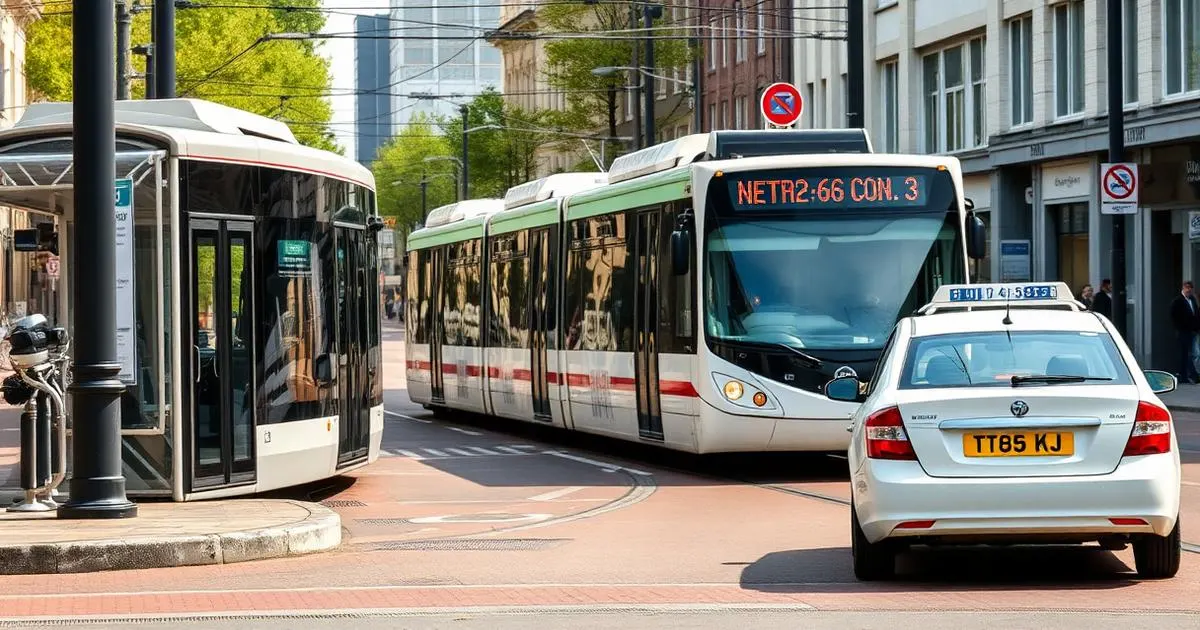
Dutch public transport is dense in the cities and thin in between. Within Amsterdam, Rotterdam or Utrecht a tram or metro is usually quicker than a car. In a village at 05:30, it may not be running at all. The decision comes down to three things: whether a service exists at the time you need it, how far your door is from a stop, and how much you are carrying.
Where public transport is strong
- Inside the four big cities during the day, where trams and metros run every few minutes.
- Journeys along a direct line with no transfers.
- Travelling light, alone, without a hard deadline.
Where a taxi is the practical answer
- Early mornings and late nights, when the first or last service does not fit your plan.
- Villages and industrial areas with an hourly bus at best.
- Two or more transfers, especially with luggage or in the rain.
- Groups: a minibus taxi carries up to eight people for one fixed price.
- Any journey where arriving late has a real cost.
A quick way to decide
Add up the walking, waiting and transfer time for the public transport option, not just the in-vehicle time. If the total is more than roughly twice the driving time, or if a single missed connection would break your plan, a taxi at a fixed price is usually worth it.
For groups, divide the taxi price by the number of passengers before comparing — it changes the picture more than people expect.
How booking a taxi with Taxiritje.nl works
Prices are based on the actual road distance in kilometres between your pickup address and your destination, so you always know the amount before you book. Payment is online by card or iDEAL, and you receive a confirmation by email with the driver details, the pickup time and an invoice with VAT for business trips.
You book online in a few steps. Enter your pickup address with house number and postcode, add your destination and choose the date and time. The price you see is the price you pay: it already includes luggage, tolls, parking at the airport and waiting time, so there is no meter running during the journey and no surcharge at night or at the weekend.
Reservations are possible up to three hours before pickup, and you can book a one-way trip or a return in the same booking. For flights you enter your flight number; we then follow the actual landing time and include up to 80 minutes of free waiting time at the airport. For a pickup at a home or hotel address we include 15 minutes.
- Fixed price per journey, confirmed by email before the driver is assigned.
- Sedan or estate car for 1-4 passengers, minibus for 5-8 passengers.
- Extra stops along the way can be added while booking.
- Changes and cancellations online up to 24 hours before pickup; call 085 060 7086 within 24 hours.
Frequently asked questions
Does public transport run all night in the Netherlands?
Is a taxi worth it for a short city ride?
Read more and arrange your trip
About the author
Taxiritje.nl editorial team · Planning and customer service
The editorial team consists of staff from planning and customer service at Taxiritje.nl. They write based on the rides scheduled every day and the questions customers ask about departure times, luggage, prices and bookings.
Related articles
- How much does a taxi to Schiphol cost from South Holland? — Compare your options
- Is a taxi cheaper if you travel with multiple passengers? — Compare your options
- Is a Fixed Taxi Price Better Than a Taximeter? — Compare your options
Book a taxi at a fixed price
Choose your route, see the price straight away and complete your booking online.